
Life Cycle of A Pinot Noir Vineyard
Calendar of Activities at Olivet Grange Vineyard
What does the calendar look like for taking care of an organic and sustainable vineyard in the Russian River Valley?
Located in Sonoma County’s Russian River Valley, Inman Family Wine’s estate vineyard, Olivet Grange (OGV), has been farmed with only organic inputs since it was planted in 2000. The Certified Sustainable vineyard is planted to Pinot Noir and Pinot Gris.
There are 12,500 Pinot Noir vines planted with 6×4 on this 10.5 acre plot. The field has 5 different clones of Pinot Noir – 114, 115, 667, 777 and 828. There are only 1000 Pinot Gris vines planted. The many award-winning, high-scoring wines produced by this beautiful Russian River Valley vineyard year in, year out attest the quality of this property, located in a region of the valley called the Santa Rosa Plains.
- Take a look at a birds eye view of the Olivet Grange Vineyard on our Instagram Page.
- Why do Pinot Noir and Pinot Gris love the Russian River Valley? We have answers.
Maintaining the vineyard is a year-round activity. Keep scrolling to see what our vineyard calendar looks like and learn more about the terms below.
Vineyard Calendar
MONTH |
– VINEYARD ACTIVITY – |
| January | Dormacy |
| February | Dormacy, pruning |
| March | Pruning, tying canes, bud-swell |
| April | Bud-break, rapid shoot growth, frost patrol |
| May | Bloom, mowing, sunflowering (weed control), trunk-suckering |
| June | Fruit set, berries swell, lateral shoot removal, removal of fruit on short shoots |
| July | Bunch-closure, verasion begins. |
| August | Grapes ripen, are fully colored and begin to soften. Harvest for sparkling and rosé begins. |
| September | Harvest Continues |
| October | Dormancy begins: vine leaves change color and fall, Winterization: erosion control installed |
| November | Dormancy |
| December | Dormancy |

Bud-Swell
Bud-Swell signifies the end of dormancy and the beginning of the grapevine’s annual growth cycle. Buds begin to swell and look like little popped kernels of corn – we call it the “popcorn stage”

Bud-Break
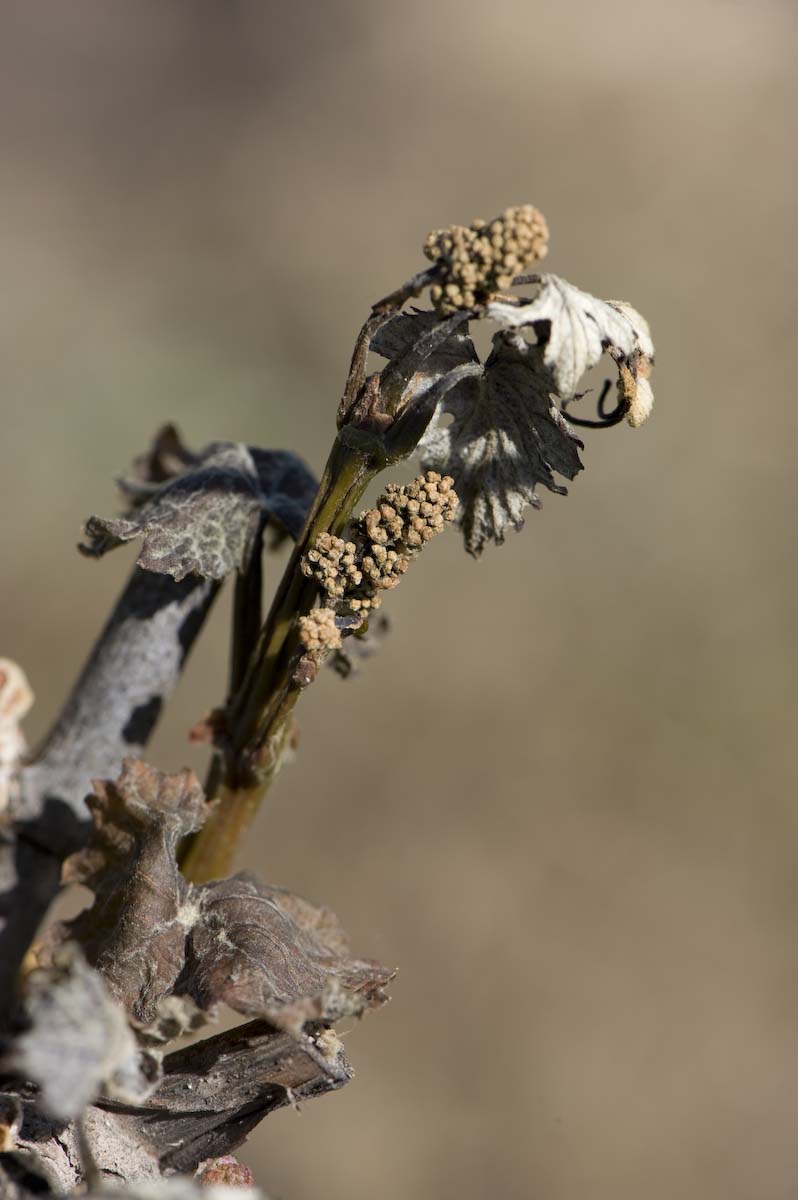
Bud-Break occurs as spring temperatures begin to rise and the swollen buds burst open revealing tiny shoots and leaves. At this early stage grape vines are very susceptible to frost.
Frost Protection
Frost Protection at Olivet Grange only two-thirds of the Olivet Grange Vineyard is protected by micro-sprinklers. The nighttime temperatures are closely mentored once we have budbreak and if the temperatures/dewpoints look as though they will fall below 32F/0C we turn on the sprinklers and as the water droplets fall on the young shoots they form ice cocoons around the shoots and keep them at freezing. The danger is when the temps drop below freezing and the cold burns the shoots, destroying them.

Flowering
Flowering of the grapevine is a critical time for the formation of the fruit. Grapes are self-pollinating so they do not need bees or other pollinators. What they do need is just the right weather conditions to achieve a good fruit-set. If it is too windy, the pollen on the flowers blows off and does not fertilize the neighboring flowers; if it is raining, the water washes the pollen away; and, if it is too hot, the pollen is baked on and pollination does not occur. When this happens and you have incomplete cluster formation, this is called “Shatter” and can also lead to clusters that have some tiny berries as well as normal sized-berries and we call this “hens and chicks.”
Shoot Thinning
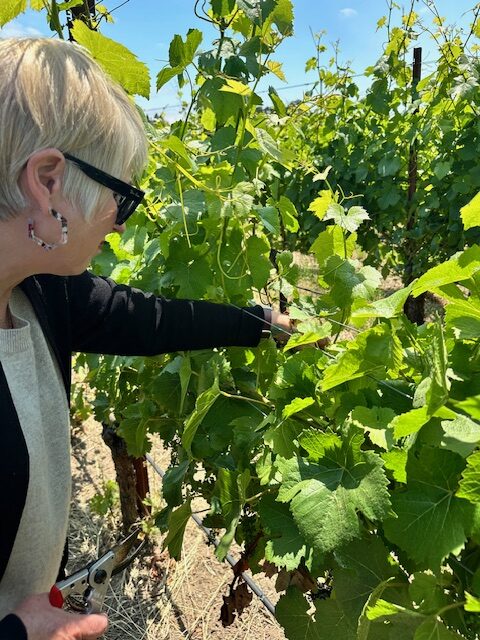
Shoot Thinning is the process of removing non-essential shoots to improve the quality of the fruit. This work is highly skilled and done by hand. Shoots that crowd the crown of the vine are removed. Occasionally two shoots come from one node and then the weaker shoot is removed. Lateral shoots, which form along the primary shoots are also removed at Olivet Grange Vineyard. These laterals carry second crop and they can take energy away from the primary crop. The removal of laterals also opens up the canopy to allow better flow of air which reduces the risk of mildew or mold.
Pruning & Trunk Suckering
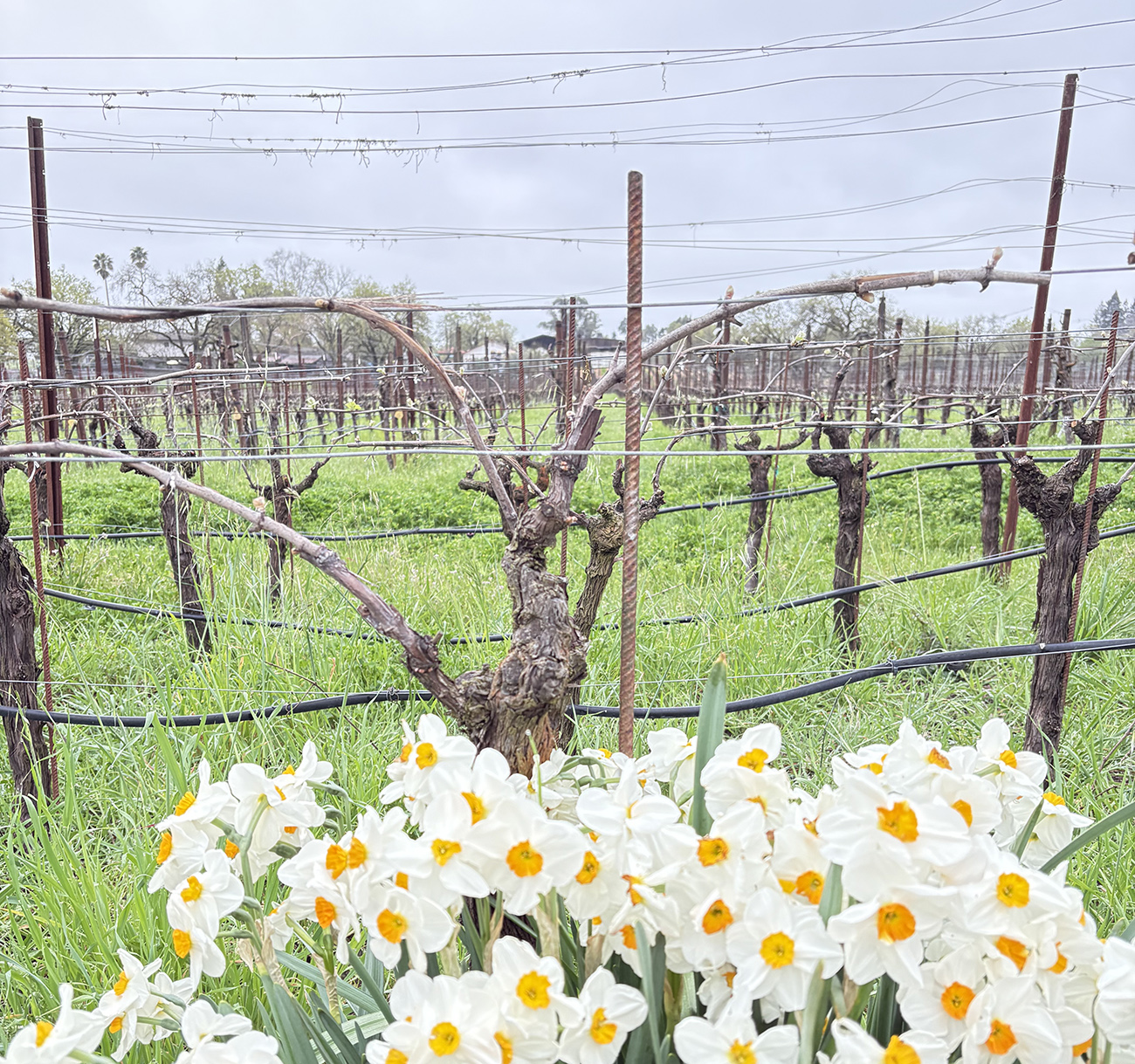
Pruning at Olivet Grange Vineyard is all done by hand and is done based on the cycles of the moon. Our vineyard is cane pruned so each February/March all of the previous years old growth is removed and two or three new shoots are left with 8-10 nodes (future buds). Each of these are later tied by hand to one of the two fruiting wires of the trellising system. The previous year’s growth is left in the rows and when the first mow takes place, the prunings are chopped and compost in place, returning nutrients to the soil.
Trunk Suckering is the removal of shoots that spring from the trunk, usually at the very base. This is back breaking work and is all done by hand.
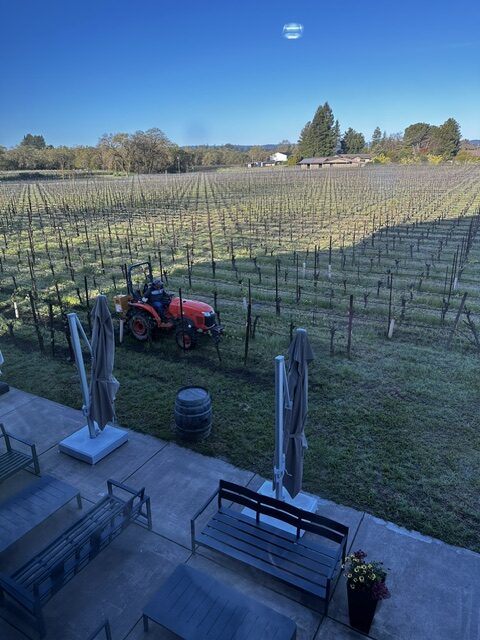
Sunflower & Tornado
Sunflower is a tractor accessory we use to weed under the vine rows. In an organically farmed vineyard we do not use any weedkillers or pre-emergents. In 2025 we used a new tool called a tornado which did an excellent job of mowing under the vine rows.
Come visit us for a tasting among the vines.
Most of our tastings take place on the patio surrounded by the vineyard. Certain times of the year we also offer tastings with the winemaker Kathleen Inman where she will guide you through the vineyard.
More information on Tastings at Inman Family here.